Content Factory: from one AI node in n8n to a full 1.3M-ruble system in six months
The brief: the client had an idea - put content on autopilot instead of grinding it out by hand. We started simple and grew it into a full system.
How we built it (six months): started with one bare-bones AI node in n8n, just to test cheaply whether the idea would fly. It did, so we kept digging: rebuilt the core in Python, added AI-driven photo selection (understands prompts in Russian), carousel generation, our own video pipeline (we cut and format it ourselves), a moderation queue, and scheduled auto-posting to Telegram, MAX, VKontakte, Pikabu, Zen, and the website - any major social network or video platform can be plugged in. We kept poking at it, rebuilding, layering on features until it was polished. By the end: an orchestrator brain that runs the content plan and learns from the numbers on its own.
What the client paid for, and what they got:
- Total budget of 1.3M rubles, broken into stages - paid for results at each step, not a pig in a poke
- Daily publishing across every channel, with zero day-to-day involvement
- Ongoing costs now: ~50K rubles/month for maintenance + $100-240 for subscriptions and servers + 30K rubles/month for a "babysitter" who watches over it and tunes it
- The system stays with the client and keeps running - they can keep building on it
A swarm of 15 AI agents instead of a dev team
The brief: carry the workload of a full studio with just two people - without drowning.
What we built: a control panel running 15 AI agents, each with its own role - layout, backend, QA, SEO, automation. Each one has its own memory and its own "head." Drop in a task as a single line, and the agents break it down, do the work, and deliver the result. We just review it. Watchdogs monitor everything from two separate machines, and backups ship out to a standby cluster.
What this delivers:
- Two people running a full studio's workload - no salaried team behind it
- Agents work through the night - results are ready by morning
- This very website, and the chat you're talking to, were built by them
I'm now taught as a case study on the course I'm still taking
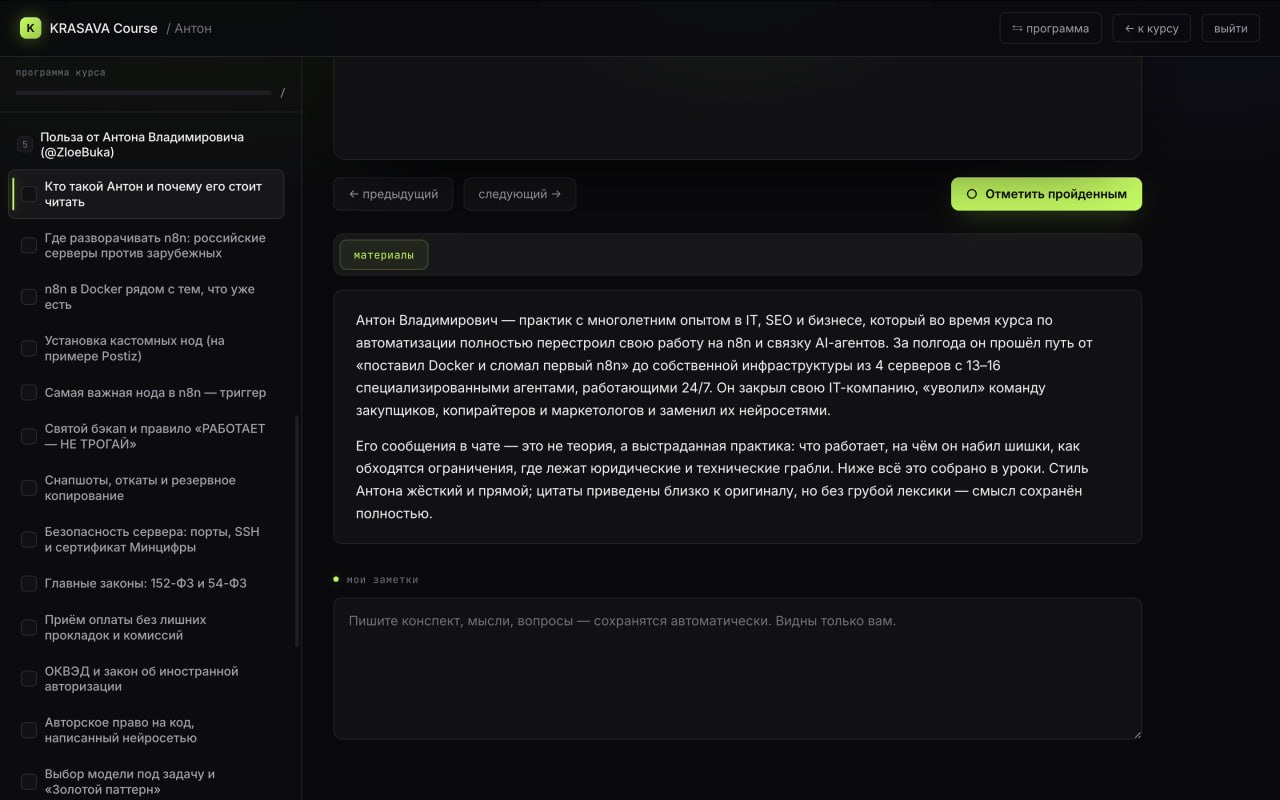
How it happened: I joined an automation course called "Synthesis Master," now on my second cohort. Here's the twist - my own messages from the class chat got pulled into a dedicated lesson block called "Lessons from Anton." They broke down our shift to n8n and a swarm of AI agents, our four-server infrastructure running 13-16 agents around the clock, and every legal and technical headache along the way - turned it all into course material.
I wouldn't have believed it myself without seeing the screenshot. Learning and teaching at the same time, and nobody planned it that way.
Why this works in your favor: you're not getting a YouTube theorist - you're getting a practitioner whose actual work gets taught in class.
An office AI secretary in production: a three-server cluster, memory that never gets wiped
The brief: the client wanted an assistant inside the work chat - one that replies to staff, remembers everyone, and doesn't go down if a server hiccups.
What we built: an AI secretary with three layers of memory (short-term, mid-term, long-term) spread across three servers - if one node dies, the system keeps going. Every user gets their own sandbox, and personal data stays within Russia. We tried to break it through the chat ourselves - it held up.
What this delivers:
- Handles 1,000+ concurrent users - scale is built into the architecture, not bolted on
- Fends off attacks and intrusion attempts automatically
- First response in seconds, around the clock; 152-FZ is followed for real, not just on paper
Complex integrations: compliance automation and working within legal limits
The brief: the stuff other vendors shrug at and call "impossible" - automated replies to banks under 115-FZ, access to services that are blocked domestically, connecting systems that don't talk to each other out of the box.
What we built: a 115-FZ compliance service that reads a bank's request, extracts documents through OCR (PDFs, scans, photos), and assembles the response package on its own - work that used to take an accountant days. Separately, we built legal gateways to the services the client needed, routed through domestic infrastructure - working within the law and its exceptions, not around them.
What this delivers:
- Bank response packages assemble themselves: 11 banks, 5 request types
- Data stays within Russia - 152-FZ, for real
- Nothing broken: we cut out manual labor and work around barriers within the bounds of the law
Industrial catalog: 30,000 SKUs sorted from a 1C export overnight
The brief: a manufacturing client had a catalog with tens of thousands of items dumped out of 1C with zero structure. Customers were calling in just to find the right bearing size, because the site was useless for it.
What we did: taught the site to parse the product listings itself - type and dimensions get pulled straight from the name, based on GOST standards. Added smart filtering by size, plus search by string like "45x85x23," the way people are used to asking over the phone. Threw in a dark redesign and SEO structure on top. We didn't touch the 1C export itself - everything sits on top of it.
What this delivers:
- The catalog sorts itself into categories with no manual work
- One-line size search means fewer "help me find this" phone calls
- The catalog sort itself took one night. The whole build - filtering, search, and redesign included - shipped in two days
Organic growth on Pikabu: front-page posts with zero ad spend
The brief: the client wanted real systematic promotion, not a bot cranking out posts - something that would remember the strategy, hold the bar, and study and repeat whatever worked.
What we built: a pairing of a human editor and an AI partner with long-term memory. The AI remembers the strategy, the benchmark posts, and the performance breakdowns, drafts new posts, and learns from the reactions; the editor sets direction and hits publish. Posts land on the front page organically - tens of thousands of views without spending a ruble on ads.
What this delivers:
- Front-page hits happen systematically, not by luck
- The editor spends hours, not days
- We stood up a second version of this setup for a different client in a single day
Telegram lead generation: audience -> AI filter -> CRM
The brief: a steady stream of qualified leads, without cold calling or burning through ad budget.
What we did: scrape the target audience on Telegram, run it through an AI filter against the client's criteria, and push the qualified leads straight into the CRM with context attached.
What this delivers:
- Inbound leads on autopilot
- Managers only see leads that are already filtered - no noise
Bots built for kids: AI parents actually trust
The brief: a companion and tutor for a child with special needs, and a safe AI friend for a teenage girl instead of chatting with strangers online.
What we built: a friend-bot inside a VK Mini App that teaches reading, writing, and counting through play - plain language with no teasing, small steps, praise instead of "wrong," and it remembers progress. Mom gets her own channel with an AI expert on child development. A friend-bot on Telegram that talks as an equal, draws pictures, and remembers past conversations - with boundaries built into the system that can't be talked around.
What this delivers:
- The kid actually asks for the tablet to "talk to my friend" - letters and counting, no tears
- Kids' data never leaves the family
- If we trust AI with our own kids, you can trust it with your business